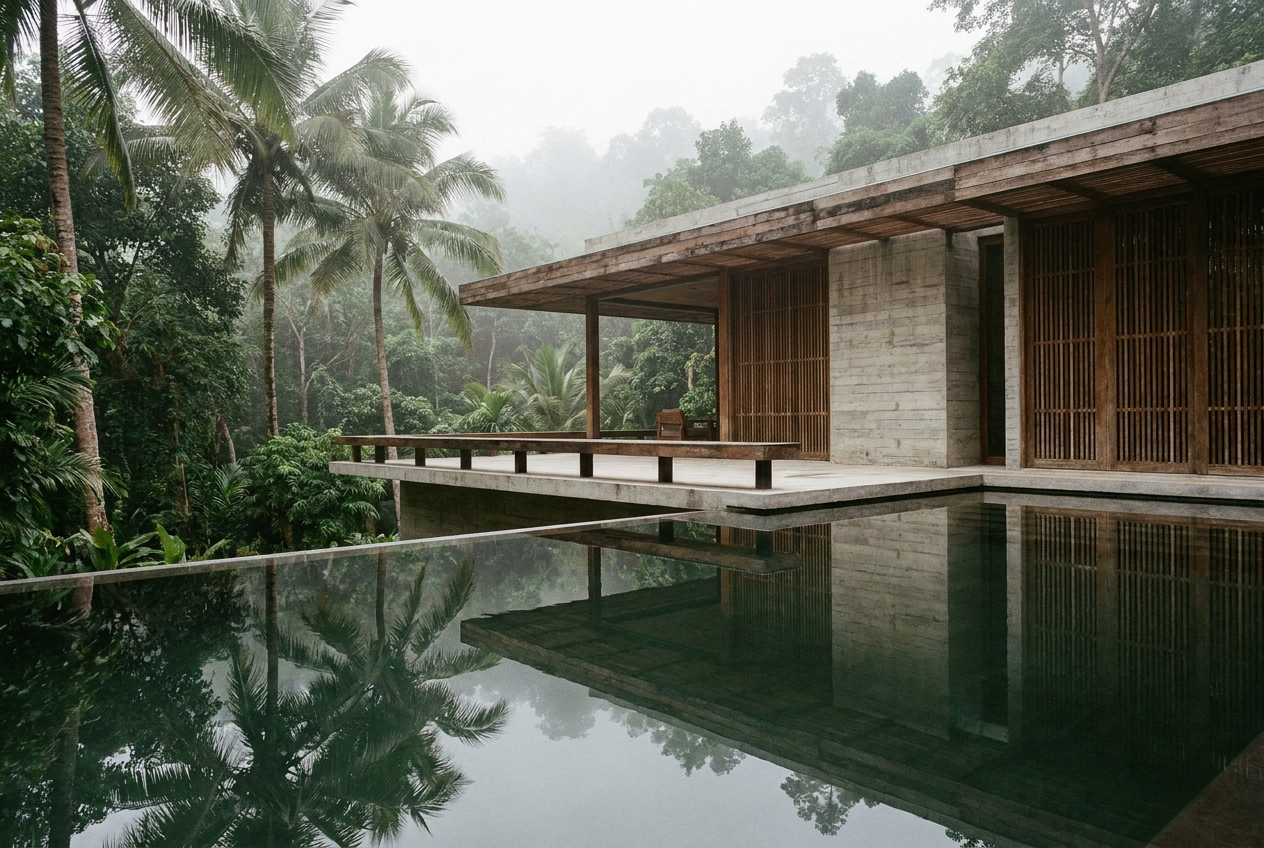
architecture · Chiang Mai
The Monastic Grid: Rethinking Northern Pavilions
An autopsy of the Lanna retreat where sacred geometry meets secular silence. On the architectural conversation between Northern Thai temple plans and contemporary hospitality design.
TL;DR
This is an article about architecture, not hospitality. It is the case for one specific lineage — the influence of Lanna temple grammar on Northern Thai contemporary hospitality architecture — and an argument about how the lineage translates successfully, and how it fails.
Three properties illustrate the success. One small property in Mae Rim, built in 2018 by an architect who prefers not to be publicly credited, demonstrates the case more economically than the marquee examples. The reader who travels in Chiang Mai can visit one of these properties plus one source-material temple (Wat Phra Sing is the canonical reference) and see the architectural conversation directly.
The article does not contain hotel recommendations in the booking sense. It contains an argument about a tradition.
The temple grammar — what we’re talking about
Northern Thai (Lanna) Buddhist temple architecture, developed primarily between the 13th and 16th centuries during the Lanna kingdom’s peak, has a small set of distinctive organizing principles. Three are relevant for this article:
First, the courtyard-and-pavilion plan. Lanna temple complexes are not single buildings; they are arrangements of separate structures around a central courtyard. The main viharn (assembly hall) is the largest structure but it is not the whole; a chedi (stupa), ubosot (ordination hall), library pavilions, and ceremonial bell-and-drum towers are arranged around it according to a plan whose proportions derive from cosmological models.
Second, the dominance of independent roof structures. Each building has its own roof; the roofs are not shared or contiguous; the silhouette of the temple complex is a constellation of individual roof forms, not a unified profile.
Third, the use of layered platforms. Buildings sit on stone or brick platforms that define a hierarchy of elevation. The chedi is highest; the viharn is mid-level; ancillary buildings are at the lowest tier. The platforms are not merely structural — they are part of the architectural argument about what matters most within the complex.
When contemporary Northern Thai hospitality architecture works, it draws on these three principles — the courtyard plan, the independent roof, the layered platform — and translates them into hospitality vocabulary. When it does not work, it copies decorative elements (the curved bargeboard, the multi-tiered roof, the naga finials) without translating the principles.
Four Seasons Tented Camp — the marquee example
The Four Seasons Tented Camp at the Triangle, near Sop Ruak in Chiang Rai province, is the most architecturally legible example of the contemporary translation. The property is small — just 15 luxury tented suites — and its plan is, in retrospect, structurally a temple complex.
The central area is a courtyard. The tented suites are arranged around the courtyard in a way that respects the temple-pavilion-and-platform hierarchy: the main pavilion (dining and gathering) is largest and most elevated; the suite tents are individually roofed and rest at a lower platform tier; the property’s spa pavilion and library pavilion are smaller volumes at the courtyard’s edge.
The tented suites themselves are individual structures — they are not shared-wall accommodations. Each has its own roof. Each is approached from the courtyard rather than from an interior corridor. The procession from courtyard to private space mirrors the temple grammar’s central-to-peripheral movement.
Where does the design succeed? The structural intent translates. A guest who has never been to a Lanna temple still feels the spatial argument of the property — the centrality of the courtyard, the dignity given to small spaces by their individual roofs, the layered hierarchy that places the dining pavilion above the residential pavilions architecturally without making the residential pavilions feel subordinate.
Where does it succeed less? The decorative-imitation problem is mostly avoided here, but the tented-suite roof forms occasionally reference the curved Lanna bargeboard in ways that read as costume rather than translation.
137 Pillars House — the urban variant
The 137 Pillars House in Chiang Mai’s old city is the urban translation. The property’s organizing courtyard is smaller than the Tented Camp’s — it is necessarily so, on a finite urban lot — but the same temple grammar is at work.
The viharn equivalent here is the property’s reception-and-dining building, a teak-pillar structure built around the property’s 19th-century heritage core. The chedi equivalent is the property’s pool pavilion, which sits on the highest platform within the site and is the silhouette element visible from outside the property’s wall. The suite buildings ring the courtyard’s edge at the lowest tier.
The urban variant has a tighter problem: the property must be a hotel as well as a temple-grammar exercise. The 137 Pillars House handles this by allowing the temple grammar to organize the spatial plan while letting contemporary hospitality vocabulary (the spa, the bar, the cafe with afternoon-tea service) operate within the plan without disrupting its grammar. The strongest single move is the pool pavilion: a contemporary structure that occupies the chedi platform in the plan but does not pretend to be a chedi.
This is what successful translation looks like — the temple grammar organizes; contemporary hospitality occupies the organization; the two do not interfere.
The small Mae Rim property — the most legible example
The strongest single example of the translation, in our reading, is a smaller property in Mae Rim — north of Chiang Mai city, in the Mae Sa valley — built in 2018 by an architect who has asked not to be named publicly (the property’s commercial positioning is “discreet” and the architect honors that). The property has six villas; we are not publishing its name in this article.
The plan is unusually pure. The central courtyard is rectangular; the villas are arranged around it in a 2-3-1 pattern that mirrors a small upper-Northern temple’s pavilion arrangement. The property’s central building (dining and reception) sits at one end of the courtyard at the highest platform tier. The villas are at the lowest tier; their individual roofs are visible from the courtyard but their private outdoor spaces are not.
Three details elevate the property:
First, the platform-step language. The site has a slight natural grade; the architect uses the grade rather than fighting it. Walking from courtyard to villa, the guest descends one platform step. The descent is small (perhaps 40 centimeters) but it is felt; it marks the transition from public to private. The platform language is not decorative; it is processional.
Second, the roof rhythm. Each villa’s roof is a simple gable, oriented perpendicular to the courtyard’s long axis. The roofs are not “Lanna-styled” in the decorative sense — no curved bargeboards, no multi-tiered gables, no naga finials. They are simply, structurally, independent gables. The temple grammar appears as rhythm, not as costume.
Third, the bell-and-drum tower equivalent. At the courtyard’s far end from the dining pavilion, a small vertical structure rises above the wall — the property’s water-tower-and-staff-quarters volume. The structure is functional; it is not pretending to be ceremonial. But its placement and its verticality complete the temple grammar’s silhouette. The plan reads as a temple plan; the building reads as a hotel.
This is the article’s argument in a single example. The translation succeeds when the architect understands what the temple plan is doing — organizing space hierarchically, marking transitions through platforms, allowing each volume its own roof — and applies the doing without applying the surface forms.
Where the translation fails
Three failure modes are common in contemporary Northern Thai hospitality architecture:
The first is decorative imitation. A property’s main building sprouts a multi-tiered Lanna roof; the bargeboards curve toward heaven; naga finials appear at the gable peaks. The architectural source has been referenced visually but the spatial grammar — the courtyard, the platform hierarchy, the individual-pavilion principle — is absent. The result reads as costume.
The second is grammar without intent. A property correctly arranges pavilions around a courtyard with platform-tier hierarchy, but the courtyard is empty. The temple grammar evolved in service of a use — the courtyard is the gathering space for festival-day ritual; the platform tier is the embodied hierarchy of what matters most. When a contemporary property reproduces the grammar without giving the grammar anything to do, the spaces read as decorative arrangements of buildings rather than as architectural argument.
The third is the scale problem. Lanna temples were built to specific scales — the viharn is large enough to seat a community on festival days; the chedi is tall enough to be visible from the adjacent fields. When contemporary properties scale up the grammar to luxury-property proportions (the main pavilion is enormous; the courtyard is large enough for a tennis match), the proportional relationships that gave the temple grammar its dignity collapse. The plan reads as inflated rather than as referenced.
What to look for as a reader
If this article makes you want to visit the lineage directly, three things to look for:
- The courtyard’s centrality. Does the property organize itself around a courtyard, or does the courtyard exist as an accessory to a more conventional hotel plan?
- The independent-roof rule. Does each accommodation building have its own roof, visibly so, or are accommodations shared-roof structures with a Lanna-style roof skin?
- The platform hierarchy. Does the property use elevation to mark importance? Does the dining or gathering structure sit at a different platform than the accommodations?
A property that does all three is in the lineage. A property that does only the third (or only superficially the first) is referencing the lineage decoratively.
What this article is for
Thailand Luxury Privé does not publish architecture criticism for the sake of architecture criticism. We publish it because the reader who understands what they are looking at gets more from a property than the reader who does not.
If you visit the Four Seasons Tented Camp without the temple-grammar framework, you observe a beautiful resort. If you visit it with the framework, you read the resort as an architectural argument — and the property’s design choices become legible as choices.
The article is not a recommendation to book any property. It is a recommendation to look more carefully at the properties you do visit.
Verified: 02 June 2026 · Editor: P. Kittikorn · Field visits: Four Seasons Tented Camp (Q1 2026), 137 Pillars House (multiple visits 2023–2026), unnamed Mae Rim property (Q4 2025). Reference temple visits: Wat Phra Sing, Wat Suan Dok, Wat Chedi Luang, all in Chiang Mai’s old city.
Disclosure: This article makes no specific property recommendations and contains no affiliate links. See Affiliate Disclosure for the publication’s overall practice.
Frequently Asked Questions
- Are you actually saying the temple plan influenced Aman Phuket's pavilions?
- No — Edward Tuttle's 1988 Aman Phuket design draws from a different lineage. The argument here is about Northern Thai (Lanna) properties specifically; Pansea Beach is a different conversation.
- Where can a reader actually visit and see this lineage?
- The Four Seasons Tented Camp in the Golden Triangle is the most architecturally accessible example. The Lanna temple complex at Wat Phra Sing in Chiang Mai's old city is the source-material reference. Visiting both within a single trip lets the contemporary translation read clearly.
- Is this an argument that luxury hospitality should adopt sacred architecture?
- No. The argument is more modest: when contemporary Lanna hospitality references temple plans, it should reference the intent, not the forms. Decorative imitation is the failure mode; structural intent is the success.
Further Reading
Thailand Luxury 2026 — A Planning Reference
The practical reference for a luxury Thailand trip in 2026 — when to go, where the weather works, what visas you need, how money moves, what travel insurance to carry, and the property + experience selections we stand behind.
Phuket vs. Koh Samui vs. Krabi: Which Thai Island for Which Trip
Three Thai islands, three weather windows, three different luxury landscapes. The trip-by-trip decision matrix — and where each island falls short.
Aman Phuket vs. Soneva Kiri vs. Six Senses Yao Noi: The Three-Way Comparison
Three properties, three philosophies, three price points. Which to choose for a couple's retreat, a family trip, a repeat Asia traveler, and where each has a weakness the marketing doesn't disclose.