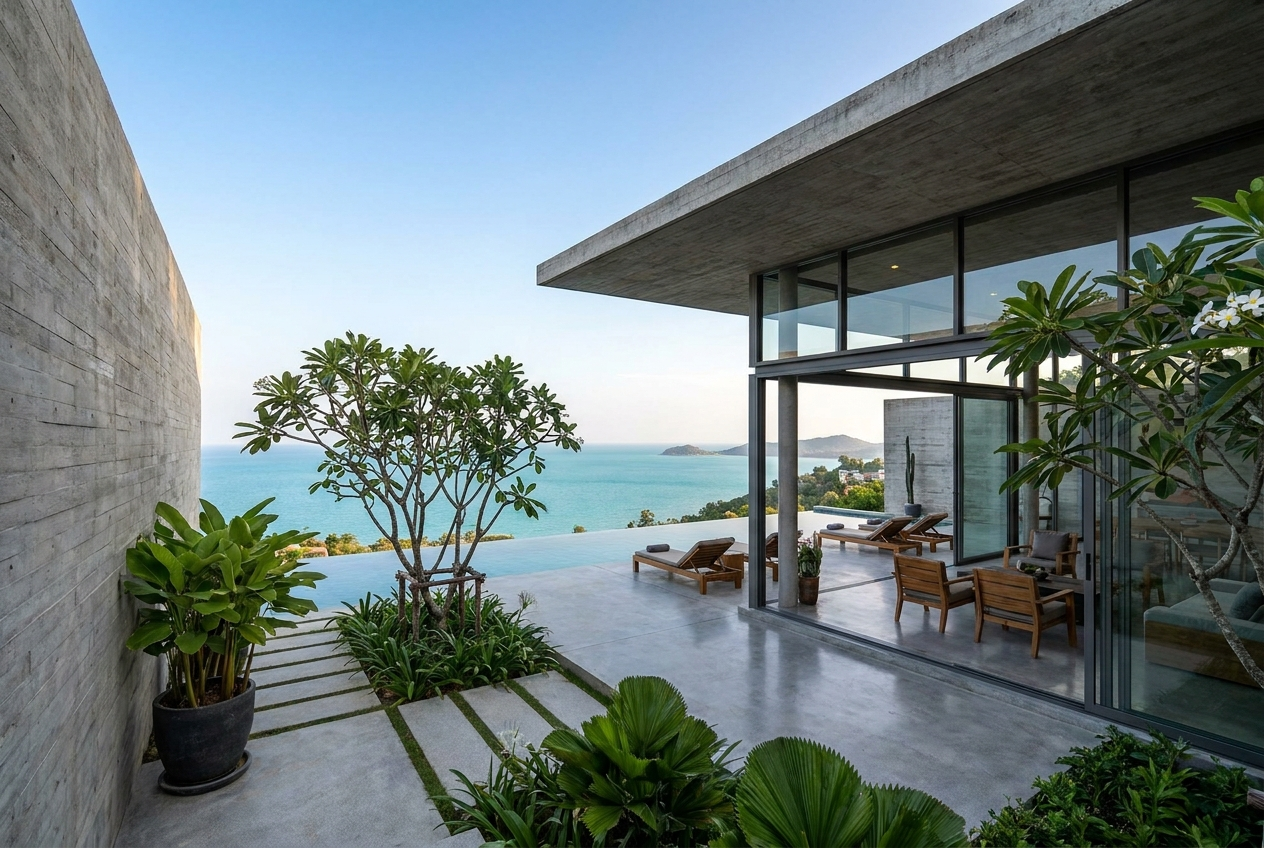
comparison · Phuket
Phuket vs. Koh Samui vs. Krabi: Which Thai Island for Which Trip
Three Thai islands, three weather windows, three different luxury landscapes. The trip-by-trip decision matrix — and where each island falls short.
Affiliate disclosure · This article contains links to partner platforms ( fora, klook) that may earn Thailand Luxury Privé a commission if you book. The commission does not change your price. Our editorial verdicts are independent of these relationships. Full disclosure.
TL;DR
Three Thai islands; three meaningfully different propositions. The choice depends on what kind of trip you are taking and when you are taking it.
- Phuket: the largest, most developed, best-infrastructure island. Direct international flights from many cities. The broadest luxury property selection (Aman, Trisara, Sri Panwa, Banyan Tree, COMO Point Yamu, plus dozens at every category below). Trade-off: noisier, more developed, less seclusion-by-default.
- Koh Samui: the family-luxury middle-tier island. Strong property selection (Four Seasons, Six Senses, COMO Shambhala, Vana Belle, W). The most stable weather across the year. Trade-off: less marquee luxury inventory than Phuket; the very top of the luxury market is thinner.
- Krabi (including Koh Yao Noi and Koh Phi Phi): the natural-environment-integrated set. The Phang Nga karsts are the regional landscape signature, and the properties (Six Senses Yao Noi, Rayavadee Krabi, Phulay Bay) integrate that landscape into their architecture. Trade-off: more logistical complexity (boat transfers, weather sensitivity), fewer dining/cultural options outside the properties.
If you have never been to Thailand: Phuket. If you are bringing children 5–12: Koh Samui. If your trip’s organizing principle is natural-environment: Krabi.
Phuket — the developed-luxury island
Phuket is Thailand’s largest island (around 540 sq km) and its most developed by an order of magnitude. The island has its own international airport with direct flights from Hong Kong, Singapore, Seoul, Tokyo, Dubai, Sydney, and several European cities; from Bangkok it is a 80-minute domestic flight on Bangkok Airways or Thai Airways with dozens of daily departures.
The luxury property landscape on Phuket is the most varied in Thailand. The high end includes:
- Aman Phuket — Pansea Beach headland; the regional architectural archetype (covered in our editorial review)
- Trisara — Layan Beach; the boutique-headland alternative; family-strong
- Sri Panwa — Cape Panwa; the design-driven option with the strongest sunset bar in the regional set
- Banyan Tree Phuket — Bang Tao; the original Banyan Tree property; mature gardens and lagoon-side spa
- COMO Point Yamu — Cape Yamu; the design-and-wellness option with the Phulay Bay-style modernism
Plus strong mid-luxury options: Anantara Mai Khao, Twinpalms, Amari, the Marriotts.
What Phuket gets right: infrastructure. You can get anywhere on Phuket in an hour or less; the dining scene outside resorts is substantial (Bangkok Times restaurant in Cherngtalay is one of Thailand’s strongest contemporary Thai kitchens; the night markets and seafood restaurants on the east coast are reliable); ground transfer is professional; medical access is excellent (Bumrungrad has a Phuket branch). For a single luxury trip that needs to do multiple things, Phuket is the most efficient choice.
What Phuket gets less right: seclusion. The west coast beaches outside the headland properties are heavily developed; Patong is the cliché party-tourist district and should be avoided unless that is the trip’s reason; certain shoulder-season weather windows can be unstable.
When to visit: mid-November through mid-February (peak dry season). Mid-March through mid-October you accept weather risk for 20–30% lower rates.
Koh Samui — the family-luxury island
Koh Samui is the eastern Gulf of Thailand island (around 230 sq km) accessed by Bangkok Airways with a property-monopoly direct flight from Bangkok (60 minutes) plus connections from Singapore, Hong Kong, and Kuala Lumpur. The airport is small and well-organized.
The luxury property selection on Koh Samui is meaningful but narrower than Phuket. The high end:
- Four Seasons Resort Koh Samui — Laem Yai; the regional family-luxury benchmark; outstanding kid program
- Six Senses Samui — Choeng Mon; the Six Senses regional wellness flagship
- W Koh Samui — Mae Nam; the design-driven option for younger travelers
- COMO Point Yamu — wait, that’s Phuket. COMO Shambhala Estate Koh Samui (the Koh Samui sister property) is the wellness-retreat option
Plus the Vana Belle, Ritz-Carlton, Anantara Bophut, Banyan Tree Samui at the high-mid tier.
What Koh Samui gets right: family-luxury fit. The Four Seasons Koh Samui is the regional benchmark for family-luxury hospitality — large villas, beach club designed for both adults and children, the children’s program is substantially staffed and creative. The island’s overall pace is calmer than Phuket. Weather is the most reliable of the three islands — Koh Samui’s wet season runs October–December (different from the western islands’ April–October), so June–September is reliably dry in Samui while Phuket and Krabi are unstable.
What Koh Samui gets less right: the absolute top of the luxury market is thinner. There is no Aman-equivalent on the island; the marquee single-property experience is not at Phuket’s level. For pure-luxury couples retreats, Phuket has more to offer; for family-luxury, Samui is the right answer.
When to visit: June through September (dry season; counter-cyclical to Phuket). Avoid October through December (wet).
Krabi region — the natural-environment island set
Krabi is the mainland province on Thailand’s southwest coast, plus the islands of the Phang Nga Bay and Koh Yao archipelago — Koh Yao Noi, Koh Yao Yai, Koh Hong, Railay, Koh Phi Phi. The luxury property infrastructure is the smallest of the three, but the natural-environment quality is the strongest — Phang Nga Bay’s limestone karsts are the regional landscape signature.
Access: Krabi has its own airport with direct domestic flights from Bangkok and a handful of regional international connections. From Krabi airport most luxury properties require a boat transfer (45–75 minutes). Some properties (particularly Koh Yao Noi) are accessed via Phuket airport plus boat — the standard Six Senses Yao Noi pathway.
The luxury property landscape:
- Six Senses Yao Noi — Koh Yao Noi; integrated wellness; karst views (covered in our three-way comparison)
- Rayavadee Krabi — Railay Beach; the boutique-villa option with peninsula isolation
- Phulay Bay, a Ritz-Carlton Reserve — Tubkaek Beach (Krabi mainland); the architectural showstopper of the region
- Banyan Tree Krabi — Tubkaek Beach; sister property to Phulay Bay; villa-pool standard
- The Tubkaak Krabi Boutique Resort — Tubkaek; the boutique alternative
Plus the Koh Yao Yai resort cluster for travelers seeking even quieter alternatives.
What Krabi gets right: natural-environment integration. The Phang Nga karsts visible from properties’ beaches are spectacular; the property architecture in this region is the most consistently natural-environment-integrated in Thailand; the trip’s atmosphere is genuinely quieter than Phuket or Samui.
What Krabi gets less right: logistics. Boat transfers add complexity and weather sensitivity. The dining and cultural options outside properties are thinner — for travelers who want to mix property time with off-property exploration, Krabi requires more planning. Several properties are effectively closed during heaviest monsoon (mid-September through mid-October).
When to visit: mid-November through mid-February (peak dry season). Boat transfers are most reliable in this window.
Weather decision matrix
The three islands have meaningfully different weather patterns. This affects when you should choose each.
| Month | Phuket | Koh Samui | Krabi |
|---|---|---|---|
| January | Dry — peak | Dry | Dry — peak |
| February | Dry — peak | Dry | Dry — peak |
| March | Dry | Dry | Dry |
| April | Shoulder — humid | Dry | Shoulder — humid |
| May | Shoulder — start of wet | Dry | Shoulder — wet |
| June | Wet — light | Dry — peak counter | Wet — light |
| July | Wet | Dry | Wet |
| August | Wet | Dry | Wet |
| September | Wet — heaviest | Dry | Wet — heaviest |
| October | Wet — late | Wet — start | Wet — late |
| November | Drying | Wet | Drying |
| December | Dry | Wet — heaviest | Dry |
The practical takeaway: if you can only travel in June–September, Koh Samui is the right answer. If you can only travel December–February, all three work; Phuket is the most popular. If you have flexibility, mid-November to mid-February is the safest single window for all three.
Activities and excursions
| Activity | Phuket | Koh Samui | Krabi |
|---|---|---|---|
| Phang Nga Bay yacht charter | ✅ Best base | — (would need to relocate) | ✅ Closest base |
| Snorkeling / diving | ✅ Many operators | ✅ Many operators | ✅ Strongest natural reefs |
| Rock climbing | — | — | ✅ Railay is world-class |
| Spa day (non-property) | ✅ Many options | ✅ Many options | Limited |
| Restaurant scene (off-property) | ✅ Strongest | ✅ Strong | Limited |
| Night markets | ✅ Phuket Old Town Sunday market | ✅ Bophut Fisherman’s Village | Limited |
| Cultural sites | ✅ Big Buddha, Wat Chalong, Old Town | ✅ Big Buddha, Hin Ta and Hin Yai | ✅ Wat Tham Suea (Tiger Cave) |
| Day boat to neighboring islands | ✅ Phi Phi, James Bond Island | ✅ Ang Thong Marine Park | ✅ Hong, Phi Phi, Lanta |
| Wellness clinics (non-property) | Limited but emerging | Strong (BDMS) | Limited |
Activity bookings: for most of the activities above, Klook and GetYourGuide are the most reliable booking platforms. Both pay us a commission on activity bookings made through these links — see Affiliate Disclosure.
When to choose each
| Trip type | Recommendation |
|---|---|
| First Thailand trip | Phuket |
| Couples retreat — pure luxury | Phuket (Aman or Trisara) |
| Family with children 5–12 | Koh Samui (Four Seasons) |
| Wellness as primary motivation | Krabi (Six Senses Yao Noi) or Samui (COMO Shambhala) |
| Anniversary / honeymoon (couples) | Phuket (Trisara) or Krabi (Phulay Bay) |
| Multi-generation family (3+ generations) | Koh Samui (Four Seasons) |
| Yacht charter trip | Phuket (Phang Nga base) or Krabi |
| Active rock climbing | Krabi (Railay) |
| June–September travel window | Koh Samui |
| Single-property “we don’t leave the resort” trip | Phuket (Aman) or Krabi (Six Senses Yao Noi) |
| Off-property exploration trip | Phuket |
| Quietest possible trip | Krabi (Koh Yao Noi specifically) |
How to book
Each island’s marquee properties are Fora Travel preferred partners. Booking through Fora unlocks property-specific perks at the same rate you’d pay direct.
For a Phuket trip starting at Aman Phuket: see our Aman Phuket editorial review for the booking pathway.
For a Krabi trip starting at Six Senses Yao Noi: see our Aman vs. Soneva vs. Six Senses comparison.
For Koh Samui (Four Seasons): book via Fora — includes daily breakfast and resort credit.
We earn a commission on Fora bookings — full editorial-independence statement on the Affiliate Disclosure page.
For inter-island travel logistics (ferries, charter flights, ground transfers): Klook handles most ferry routes and airport-to-property transfers.
Editorial verdict
If you have never been to Thailand and you have one trip: Phuket. The infrastructure plus the property selection plus the flight access means you can do the most in the time you have.
If you have been to Phuket and want something different: Krabi (for natural-environment) or Koh Samui (for family or counter-cyclical weather).
If you are choosing between these for a specific trip type, the matrix above is the answer. If you are choosing between specific properties within the islands, our individual property reviews and comparisons go deeper.
Verified: 25 May 2026 · Editor: Editorial Board · Pricing sources: property booking flows for the marquee properties on each island, Q1–Q2 2026 · Weather pattern source: Thai Meteorological Department long-term averages
Disclosure: Fora Travel and Klook are affiliate partners. We earn a commission on bookings through our links — see Affiliate Disclosure.
Frequently Asked Questions
- If I have never been to Thailand, which island first?
- Phuket. The flight access is simplest, the property infrastructure is the most developed, and you can sample the broader Thai luxury landscape efficiently. Return trips can target the specialized islands (Krabi for natural-environment, Koh Samui for family-luxury).
- Which has the best weather year-round?
- Koh Samui has the most stable weather pattern of the three. Phuket and Krabi share the southwest-monsoon timing (April–October wet, November–March dry); Koh Samui's monsoon timing differs — its main wet season is October–December, and it is reliably dry in June–September when Phuket and Krabi are unstable.
- Best for a honeymoon?
- Phuket if you want the strongest single-property experience (Aman Phuket, Trisara). Krabi if you want quiet and natural-environment. Koh Samui if you want active variety with reliable weather.
- Best for medical tourism + island recovery?
- Phuket. The flight access from Bangkok medical hospitals is straight forward, and Phuket has the strongest spa-and-wellness recovery infrastructure of the three.
Further Reading
Aman Phuket vs. Soneva Kiri vs. Six Senses Yao Noi: The Three-Way Comparison
Three properties, three philosophies, three price points. Which to choose for a couple's retreat, a family trip, a repeat Asia traveler, and where each has a weakness the marketing doesn't disclose.
Aman Phuket: An Honest Editorial Review After Four Days
Four days in the Pavilion. What the property does at the standard we expect from Aman. What it does less well. The case for booking — and the case against.
How Privé Verifies a Property — The Aman Phuket Case Study
What it actually looks like when we say a property is Privé Verified. The four-day visit, the questions we asked, the prices we confirmed, the things we didn't put on the page.